
What a Baltimore City Current-Owner Record Shows
SDAT returns a compact administrative record for each Baltimore City parcel, and each field serves a distinct purpose. Every field has its limit.
| Owner Name | Name shown from the last deed in the assessment system |
|---|---|
| Premises Address | Street location of the assessed parcel |
| Mailing Address | Destination used for assessment and tax correspondence |
| Account Identifier | County code 03 plus ward, section, block and lot |
| Deed Reference | Liber and folio used to locate the source instrument |
| Transfer Data | Sale and consideration fields to check against the deed |
The current owner's mailing address often differs from the premises address for routine reasons. A trustee, estate, or company may receive mail elsewhere. No field shows an occupant.
Freshness of Baltimore City Owner Records
SDAT updates its property database daily. A deed recorded today may not appear today, though. CityView is a separate extract and can lag on its own. Record the access date. When owner names conflict, preserve both rather than merging them into a new conclusion.
For title, use the latest recorded deed image. For the destination of a tax or assessment notice, use the mailing field. Say so, too. Matching each question to the right source field beats trusting the first portal result as the current owner.
Note: A daily database update does not guarantee that every newly recorded transfer is reflected the same day.
Baltimore City CityView Separates Owner Fields
CityView separates its owner fields. OWNER_1, OWNER_2, OWNER_3, OWNER_ABBR and AR_OWNER sit beside FULLADDR, MAILTOADD, BLOCKLOT, DEEDBOOK, DEEDPAGE, SALEDATE and SALEPRIC. Several owner fields keep full names intact when one display line would trim them. Block and lot tie the feature to SDAT.
CityView brings speed and spatial context. Its attributes remain an extract. If an owner name conflicts with a later deed, keep both observations with their source dates and let the deed carry the title statement.
The official CityView property layer also publishes values, zoning and structure fields, while the same CityView schema shows each owner field beside the deed, sale and mailing fields. Extra fields add no ownership proof.
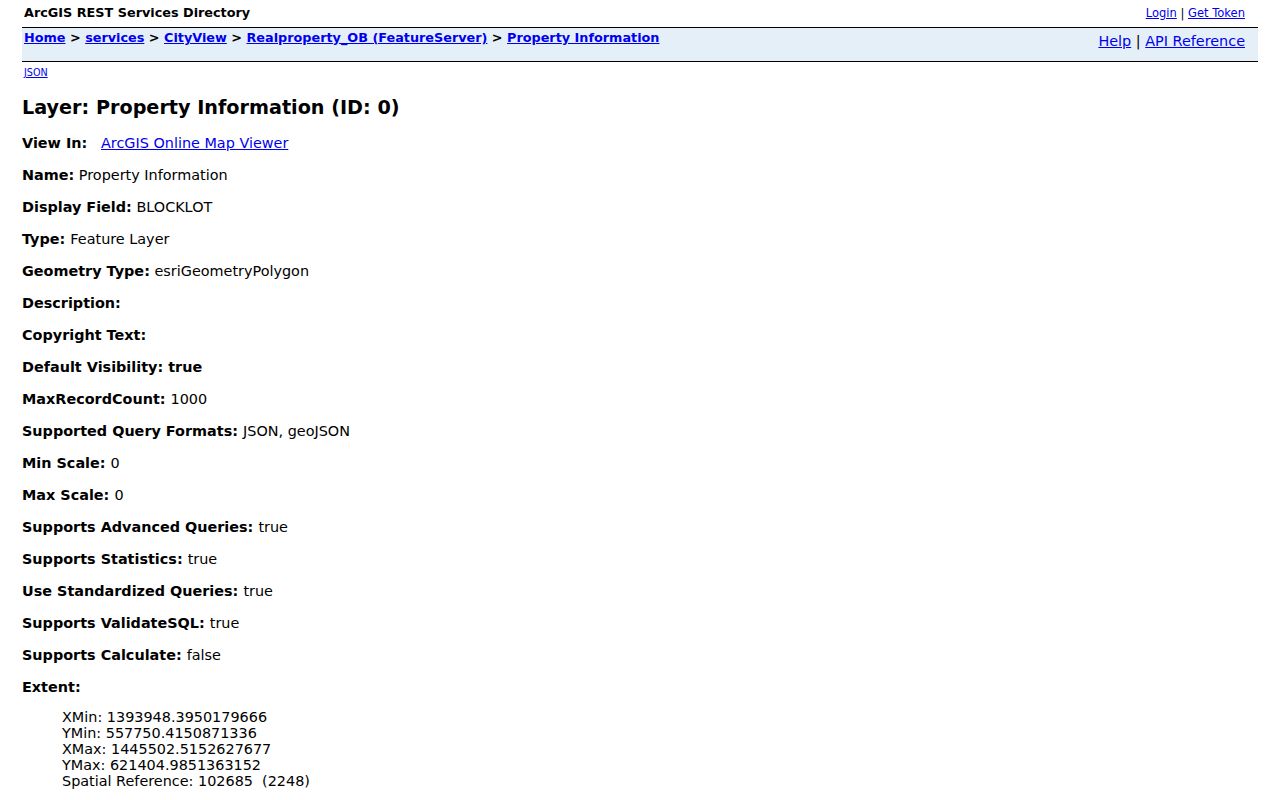
This image shows service fields only. A live query with an access date still anchors any current-owner finding.
Verifying a Baltimore City Current Owner
Sound confirmation starts with the parcel number and ends with the newest instrument conveying the interest. Keep the property identifiers constant at every step.
- Search the premises address in SDAT; save the owner, account, block/lot and liber/folio.
- Use the liber/folio and name in MDLandRec to locate the latest relevant Baltimore City deed image.
- Read the grantee and vesting language, then compare the legal description and block/lot with the parcel.
- For an LLC, search its exact legal name in Maryland Business Express and keep the registered agent distinct from the grantee.
- Owner of record
- The party shown as holding the recorded property interest.
- Vesting
- The deed language stating how and in what capacity title is held.
- Tenancy
- The legal form in which multiple parties hold an interest, when stated.
- Registered agent
- An entity contact, not automatically an owner, member or occupant.
Baltimore City LLC Owners
Sometimes a Baltimore City deed vests the parcel in an entity, and that entity name is the owner of record. Maryland Business Express adds legal context such as entity status, resident agent, officers, formation details, and filings; search by exact Business Name, Department ID, or EIN, then compare the spelling with the deed.
Treat addresses with the same care. A principal office or agent address is not the parcel's mailing address unless the records match on their own. A resident agent's name does not prove who controls the company either. State filings supply entity context. The Baltimore City deed supplies the property link.
Trusts demand the same restraint. A deed may name a trustee in a representative capacity while the trust terms stay private, and an estate transfer can name a personal representative rather than the person who ultimately receives the land. Quote the capacity shown in the deed. Do not stretch it into a claim about beneficial ownership.
Close matches need sorting. Separate them with Department ID, status, and formation details. A loose name match is not enough to tie an entity to Baltimore City real property.
Protected Baltimore City Current-Owner Addresses
Maryland Safe at Home gives eligible participants a substitute address with mail forwarding. A real-property participant may also ask that a deed be shielded. That shield applies before a transaction is recorded. Treat a withheld or substitute address as a safeguard, not a gap to defeat.
For lawful contact, use the public mailing channel exactly as supplied. Never compile owner names with personal addresses into a targeting list. A property record can answer a parcel question without revealing where anyone lives.
Baltimore City Owner Is Not Occupant
Ownership, occupancy, and mail delivery are separate facts. A deed names a grantee. SDAT lists an administrative owner and a mailing destination. The premises address simply marks the assessed site, and none of these alone tells you who lives there or manages it.
Careful wording helps. Phrases like "the most recent deed on file names" or "SDAT showed this owner" preserve the source and its limits. The broader Baltimore City who-owns guide walks the address-to-deed route in detail.
The Baltimore City tax portal can search by fiscal year, block and lot, address, or owner. Its year-specific account answers billing questions. It works as a cross-check, but a later deed still outranks it for title. Whenever a tax-derived owner name is used, keep the fiscal year attached.
If two sources disagree, say so plainly. Identify each name, its source, and its date. Report what the most recent recorded deed shows. Never average spellings or quietly pick the more familiar name.
Read the Baltimore City Owner Deed
A deed reference on an SDAT record is only a lead. It points you toward the instrument that actually establishes ownership. In MDLandRec, choose Baltimore City. Search by liber and folio, party name, block, or the applicable index series. Once the deed image opens, compare the grantor, grantee, execution date, and recording date. Also compare the legal description and the stated capacity. The grantee line gives you the present-tense name. The vesting text tells you who holds the interest. It may sit with one party, several parties, a trustee, an estate representative, or an entity.
Keep the dates separate in your mind. The signing date, settlement date, and recordation date can all differ. CityView's SALEDATE and SALEPRIC fields can help you locate the right transaction. SDAT's transfer fields can help as well. The recorded image still controls. The stated consideration proves nothing about market price either. A family, trust, or estate transfer may show a figure far from any open-market sale.
Parcel identity is your guardrail. Match the block and lot or the full legal description, never just a familiar street name. A unit, a consolidated parcel, or a later lot split can make two records look alike. Plats.net and Baltimore City block plats can clarify parcel genealogy. The deed remains the source for the conveyed interest. Where legal rights turn on the answer, a public summary never substitutes for a title examination.
State any conclusion with its source and date. The most recent deed names a grantee. SDAT may show the same administrative owner or a different one. That discipline keeps a current-owner claim auditable. It leaves room for a new instrument or a correction. It also keeps title separate from the tax mailing address. And it separates title from any guess about who occupies the property.
Reaching a Baltimore City Current Property Owner
The public owner mailing field is the right first channel. It handles a parcel-specific letter. Give the block and lot. Also give the premises address and your reason for contact. That lets the recipient identify the site without extra personal data. For an LLC, the resident-agent or principal-office record may open a formal entity channel.
A returned letter does not disprove ownership. It only shows one failed delivery. Recheck the deed and the entity status. Then try another documented public channel.
Owner is not occupant. Use contact data only for lawful property matters. Maryland law prohibits stalking and harassment, and protected addresses must be respected.