
What Baltimore City Deed Records Show
The Clerk of the Circuit Court for Baltimore City keeps the Department of Land Records. That office records and preserves deeds and other land instruments. Each deed image carries real detail. Parties, capacity, recording and effective dates, consideration, legal description, block and lot, easements or reservations, and a Liber/Folio reference all appear there. Not every deed is an ordinary sale, so the instrument type deserves attention.
| Deed Type | What It Does | Common Use |
|---|---|---|
| Warranty deed | Conveys the stated interest with the covenants in the instrument | Conventional purchase transfer |
| Quitclaim deed | Conveys whatever interest the grantor has without promising its extent | Family, estate, or title cleanup |
| Special warranty deed | Limits warranties to claims arising through the grantor | A transfer using narrower covenants |
| Trustee or representative deed | Transfers through a stated fiduciary capacity | Trust, estate, or authorized sale |
| Tax-sale purchaser deed | Records transfer after the required tax-sale process | A completed delinquent-tax proceeding |
Mortgages, releases, powers of attorney, and liens often sit in Land Records. They appear under the same names. None of those is a deed. Maryland Courts cautions that some liens stay in Land Records, and court judgments call for CaseSearch. A tax-sale list or foreclosure docket is only a lead. The resulting order and recorded instrument confirm it.
Search Baltimore City Deeds in MDLandRec
The official Maryland Land Records portal covers current jurisdiction and index searching plus Historical Indices. Pick Baltimore City as the jurisdiction. Then note the route that produced the hit, including the name form, date range, document type, book and page, and image page. Free viewing requires a Maryland State Archives account.
| Search Key | What to Enter | What to Capture |
|---|---|---|
| Grantee | Receiving party name and variants | Index, date, deed type, book/page |
| Grantor | Transferring party name and variants | Related conveyances, releases, image link |
| Block | Historic block and lot clues | Block-book entry, clerk initials, Liber/Folio |
| Direct reference | Liber/book and folio/page | Instrument image and legal description |
Deed research in the city starts with the MDLandRec jurisdiction and index landing page, the entry point for Baltimore City land record indexes.
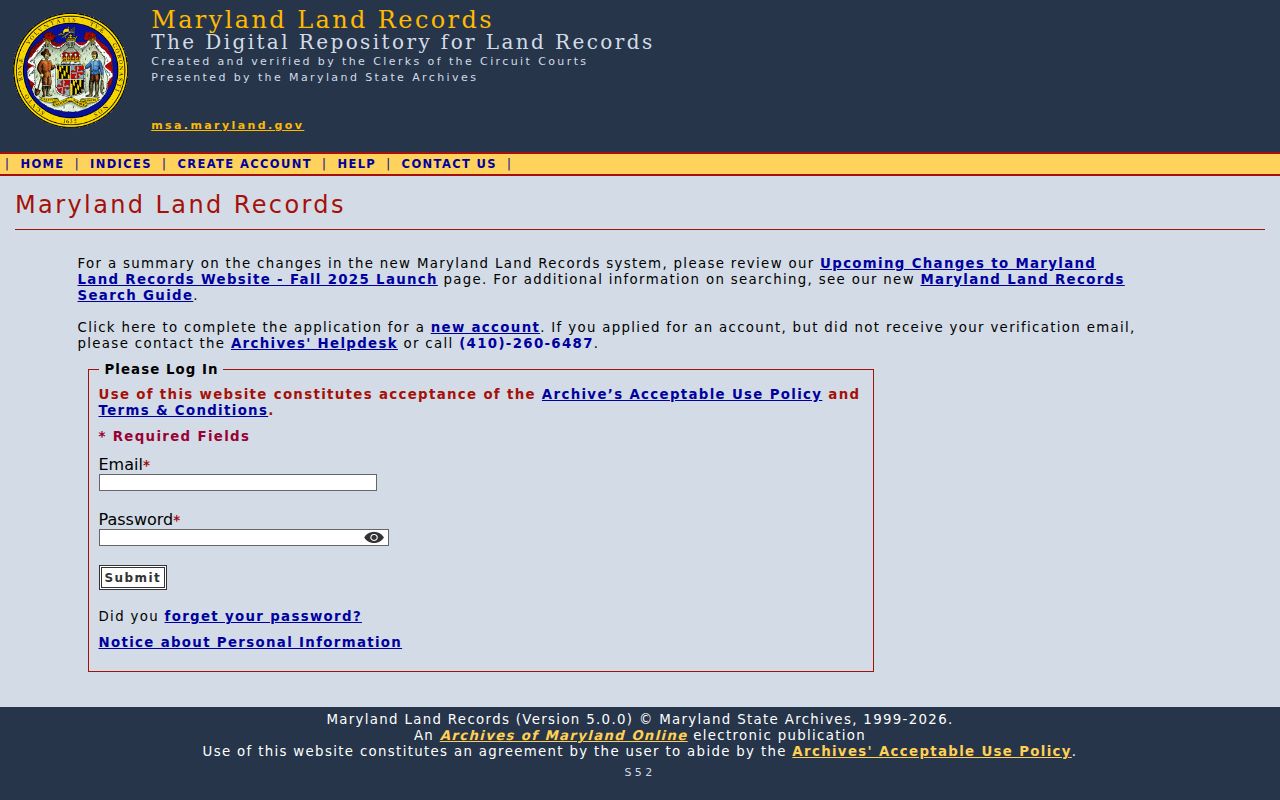
Field labels on the current search form are not fixed. Trust the visible portal controls rather than assumed field names. Note the exact query that returns each result.
Baltimore City Deed Search Starts by Block
Baltimore City organizes land records around numbered blocks. An 1886 law created the block books, covering original blocks 1 through 2073, with later ranges matching the 1888 and 1918 annexations. Street names and house numbers change. State Archives guidance says block numbers stay stable through those changes, so a block often bridges old property better than an address alone. That makes the block a strong anchor.
The Maryland State Archives block-book guide shows what an entry can hold: date, parties, instrument type, address, and book/page. For a renumbered parcel, start with the block map. Open the block book, follow the clerk initials, and retrieve the land-record image by Liber/Folio. Track changes in lot, ward, and section too.
Baltimore Deed Index Layers Since 1851
No single index spans the city's whole deed history. Baltimore City deed records sit in overlapping name, block, annexation, and map series. The right series depends on the year and on whether the parcel can be found by block.
| 1851-1965 | Unlocated Grantee Index CE219. |
|---|---|
| 1851-1976 | Block Book CE9 and Unlocated Grantor Index CE220. |
| 1851-1982 | Grantee CE166 and Grantor CE167 indexes. |
| 1887-2005 | Block map series CE3 and CE224 in overlapping runs. |
| 1918-1953 | Annexation Plat Book CE223 and New Annex Block Book CE10. |
| 1977-2002 | CE165 block books, CE285/CE286 party indexes, and later unlocated indexes. |
The electronic Cott index starts in 1989. JIS followed in 2002. Older material may appear online as scanned historic series, on microfilm, or in Archives finding aids. Before 1851, coverage is far from universal, so identify the exact series for each instrument rather than assuming it exists.
Follow the Baltimore City Grantor-Grantee Chain
A chain of title is built one link at a time. Start with the newest deed image, not an owner summary. Read the grantor from the page. Search that party as a grantee next. That search shows how the interest was acquired. Match the legal description and block/lot at every step. The same name on another parcel breaks the chain.
- Find the current purchase deed from the SDAT Liber/Folio or grantee search.
- Copy parties, capacities, dates, consideration, and legal description from the image.
- Search the grantor as a grantee, testing name-order and spelling variants.
- Confirm the same block, lot, ward, section, and description.
- Move to the right historic index, block book, or microfilm series at the cutoff.
- Grantor
- The party shown transferring the stated interest.
- Grantee
- The party shown receiving the stated interest.
- Chain of title
- The linked sequence of instruments affecting the same property interest.
- Liber/Folio
- The book-and-page reference used to retrieve a recorded image.
Save the Full Baltimore City Deed Citation
An index hit only locates the deed. The image supplies the abstract. From each one, keep the instrument type, recording and effective dates, grantor and grantee exactly as printed. Also record any marital, trust, estate, or representative capacity, consideration and transfer-tax notation, Liber/Folio, image page, and full legal description.
Capture block, lot, ward, section, and street address. Map or plat references, easements, covenants, reservations, releases, and mortgage references belong in the file too. Include any subdivision or consolidation instrument as well. So do notes on which links came from an image. Add which were inferred from an index. That distinction matters. It keeps a plausible name sequence from masquerading as proof that every instrument affects the same land.
Old Baltimore Addresses Need Maps and Directories
The State Archives workflow opens with a Baltimore directory. It pinpoints the street, cross streets, or block face before the search moves through the street index, block map, block book, clerk initials, and Liber/Folio. Directory collection SC2898 holds early volumes. It also holds long nineteenth-century runs. Pratt Library, meanwhile, describes roughly seventy digitized directories spanning the early 1800s into the 1920s.
For 1851 through 1888, the guide points to MSA CM196. For the New Annex period of 1918 through 1953, it points to CM197. A gap in one run is not the end. Check the preceding and following block-book runs. A lot may have been split, combined, renumbered, or carried under an earlier jurisdiction after annexation.
City Archives Deeds Form a Partial Collection
The Baltimore City Archives holds a useful but partial deed collection. Its real-estate holdings include deed copies covering 1796 through 1912. These were transferred to the archives in the 2000s. The archives also holds a city-owned deed index spanning 1854 through 1904. There is also a tax-sale volume for 1889 through 1926 and four plat reels. Gaps and missing numbers run through the copied deeds. Their arrangement is not fully understood.
An item missing there does not mean a deed never existed. Cite the box, reel, deed number, or series first. Then verify through Land Records or the State Archives. Survival is uneven. So Baltimore City deed records should always carry a source and series citation rather than passing as one seamless database.
Get a Baltimore City Deed Copy
Viewing an image takes a free Maryland State Archives account on MDLandRec. If that fails, use a courthouse public terminal. You can also contact the Department of Land Records through the Clerk of the Circuit Court for Baltimore City at 111 N. Calvert Street, Baltimore, Maryland 21202, phone 410-333-3733. Bring the jurisdiction and Liber/Folio whenever you can.
Ordinary copies ran $0.50 per page in Maryland Courts' inspected guidance. Confirm current charges for certification, oversized plats, and remote ordering. Clerk staff will assist once a reference is known. They cannot complete instruments, pre-review a deed, perform a title search, or give legal advice.
Recorded, not guaranteed. Baltimore City deed records show instruments accepted into the record. They are not a title opinion, and an empty search does not prove that no lien, prior owner, or unrecorded interest exists.
Baltimore Has No Verified Fraud-Alert Signup
Baltimore City publishes no verified property-fraud alert signup. The tax, SDAT, court, and recording offices offer no official enrollment. A commercial title page or parcel viewer is not a substitute. A genuine alert service comes with a real signup workflow from the responsible office.
Owners can still watch for trouble. Retain your latest deed citation and compare it with the current SDAT owner display. Contact Land Records about any new instrument. Maryland Safe at Home participants have a separate official route to request deed shielding before a transaction is recorded. That confidentiality program differs from a fraud notification.
If a suspicious instrument appears, preserve the jurisdiction, index entry, recording date, parties, document type, Liber/Folio, and image page. Then contact the custodian or a lawyer. Do not assume fraud from a changed name, consideration amount, or mailing address alone. Family, estate, trust, correction, partial-interest, and exempt transfers all create odd entries. Only the deed text and surrounding record can explain them.