
Run a Baltimore City Property Search
Maryland SDAT is the cleanest starting point for a Baltimore City property search. Enter an address or account identifier there first. CityView adds a GIS-linked parcel summary. MDLandRec holds the recorded deed. The city tax portal supplies a year-specific bill, and SDAT offers no public owner-name search, so an owner-only query belongs in the city tax system or the grantor-grantee land index.
- Select Baltimore City and search the street in the SDAT Real Property Data Search.
- Copy the account identifier, Ward, Section, Block, Lot, owner display, and Liber/Folio from the result.
- Match BLOCKLOT or PIN in CityView, noting the source and access date.
- Use the Liber/Folio or party name in MDLandRec and inspect the recorded image.
- Check the requested fiscal year in the Baltimore City tax portal.
Baltimore City SDAT Search Fields
The SDAT screen asks for a county and method. Its public guide documents four choices. Street Address, Account Identifier/PAN, Map Reference, and Sales Search are the options. Owner name, town, neighborhood, subdivision, and ZIP code draw no results there. Deleted accounts surface only by account identifier. So save the full key alongside any property search notes.
| Method | Input to Keep | Useful Rule |
|---|---|---|
| Street Address | Number and full street name | Omit direction and street-type suffix when the guide directs; try a truncated name plus * |
| Account Identifier | County 03, Ward, Section, Block, Lot | Use two-digit ward and section with block and lot suffix letters preserved |
| Map Reference | Map and parcel reference | Useful when an address has changed or is incomplete |
| Sales Search | Portal sales criteria | Treat consideration as a recorded transfer field, not proof of market value |
Account identifiers follow a documented pattern. County code 03 comes first, then Ward, Section, Block, and Lot. SDAT's Baltimore City-style example is 03 01 24 1111A 222B. Letters attached to the block or lot can matter. Separate internal letters after the PAN may not be part of the searchable account number.
When a Baltimore City Address Search Misses
A failed address query is not the whole story. SDAT explains why. The local government's assigned street number can differ from the number an owner actually uses. Search the full street name first. Then try the guide's shorter form, drop the house number to see the street list, or place an asterisk after a truncated street name. Preserve fractions and unit clues outside the search box, since a strict field may reject them.
Older addresses call for the Baltimore City directories and the stable block system. The Maryland State Archives collection covers 1752, 1796 through 1860, and 1863 through 1901. The Pratt Library describes a broader digitized run. Its entries reach into the 1920s. A directory entry proves neither title nor parcel identity. Use it to recover a spelling or a block face, then confirm the match against a block map, block book, deed, or tax record.
The Baltimore City Search-Key Crosswalk
Official Baltimore systems lean on overlapping but nonidentical keys. Keep every version on one line of a research sheet. That habit stops later deed or parcel checks from drifting to a nearby lot, a real risk with vacant land, condominiums, complex lots, and parcels whose street number changed.
| Current address | Keep the number, direction, street type, fraction, and unit exactly as printed. |
|---|---|
| SDAT query | Keep the exact successful search string and search method. |
| Account key | County 03 plus Ward, Section, Block, and Lot. |
| City GIS keys | BLOCKLOT, PIN, TAG, BLOCKNUM, and PARCELNUM where returned. |
| Historic variant | Old street spelling or number, directory year/page, and block-map confirmation. |
Baltimore's block numbers are remarkably durable. They survive street name and house number changes. State Archives guidance says so, and that stability makes the block a strong bridge between current parcel data and historical land indexes.
Read a Baltimore City Property Search Result
An SDAT or CityView result is a parcel summary. Copy the display exactly rather than expanding abbreviations. The mailing address is not necessarily the premises. The owner line reflects the last recorded deed, but a new recording may appear before a downstream display refreshes.
| Owner of Record | Owner Name or OWNER_1 through OWNER_3, including ET AL, ET UX, T/E, or /WF as displayed |
|---|---|
| Premises / Mailing | Street Location or FULLADDR is distinct from the notice and tax-bill mailing address |
| Parcel Keys | Account identifier, BLOCKLOT, block, lot, ward, section, PIN, and map references |
| Assessment | Current/full cash, base, phase-in, land, improvement, exemption, and credit fields |
| Physical / Map | Use, year built, structure or lot area, neighborhood, zoning, and plat reference |
| Transfer | Transfer date, consideration or SALEPRIC, and Liber/Folio or deed book/page |
The official SDAT county and search-method screen shows the choices that begin the lookup.
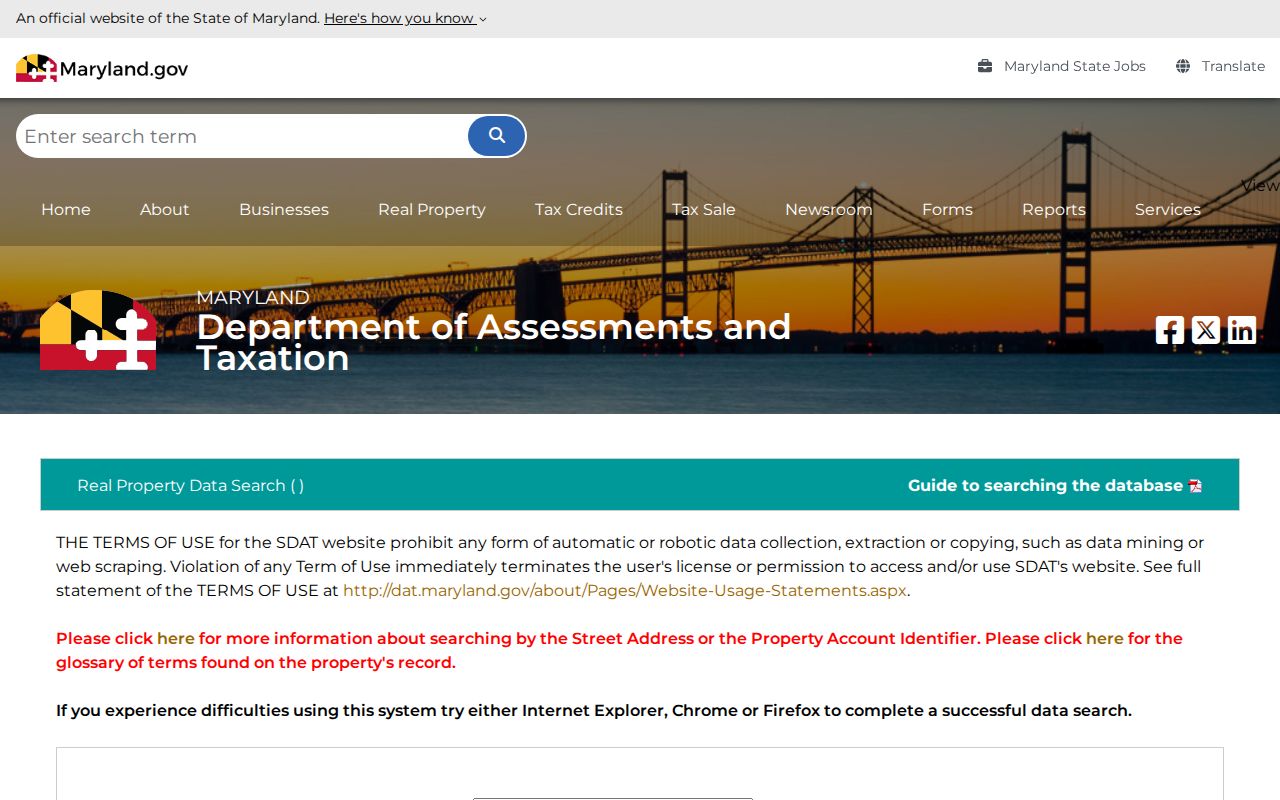
The screen states its first limit plainly: pick the jurisdiction and method before entering any parcel query. Owner-name searching belongs in another official system.
Use CityView Without Treating It as Deed
CityView is Baltimore City's real-property layer. It joins parcel geometry to a broad record card. Fields may include FULLADDR, OWNER_1 through OWNER_3, AR_OWNER, DEEDBOOK, DEEDPAGE, SALEDATE, SALEPRIC, FULLCASH, CURRLAND, CURRIMPR, ZONECODE, NEIGHBOR, YEAR_BUILD, STRUCTAREA, BLOCKPLAT, SDATLINK, and a vacant-property indicator. That range makes it handy for checking whether identifiers and summary fields line up during a property search.
Terms used across the search
Parcel or APN/PIN: a database key for mapped or assessed land. Situs address: the property's location, never the owner's mail address. Owner of record: the name tied to the latest deed the source reflects. Liber/Folio: the book-and-page pointer to a recorded instrument.
CityView remains a municipal extract. Its parcel polygon is not a survey. Owner and assessment fields can lag the recorded deed, so record the service URL, access date, object ID, and fields used whenever a result must be reproduced.
Move From Parcel Result to Baltimore Deeds
SDAT hands you the owner display and a Liber/Folio reference. The next stop is MDLandRec. Select Baltimore City there. Use the current jurisdiction/index route or Historical Indices. Free image access requires a Maryland State Archives account. Search the party name exactly as shown, then try spelling and name-order variants. Where the feature exists, carry the book and page straight to the instrument image.
Historic deeds follow a block-search tradition. Baltimore City's named index series include block books beginning in 1851, grantor and grantee indexes through 1982, and transition-era indexes through 2002. The historical route earns its keep when a modern address no longer matches an older description. The full deed workflow sits on the Baltimore City deed records page. Here, the deed reference simply verifies a general lookup.
Match Baltimore City Tax Search Years
Baltimore City's tax portal is organized by fiscal year. Its main lookup asks for a Year and accepts a Block and Lot. Separate address and owner searches sit alongside it. When a result appears, save the bill or account identifier, block and lot, premises, displayed owner, assessed and taxable base, charges, credits, delinquent balance, interest, and payment status.
Balances shift after payments and adjustments. A tax-sale redemption or a late posting can move the delinquent balance too. Owner names may be shortened. The deed can spell the same owner differently. The tax result answers one named fiscal year; for title, go back to the recorded instrument, and let the property-tax page explain bills and appeals without turning this into a tax manual.
Choose a Baltimore City Search Key
Pick the search key you already trust. An address pins down one current location fast. An owner name can pull Baltimore City records for every displayed party, though common names and entities invite false matches. A complete parcel or account key gives the tightest control when addresses conflict.
| Search Key | Best For | Where It Works | Watch Out |
|---|---|---|---|
| Address | One current premises | SDAT, tax portal, CityView | Numbers, directions, and street names change |
| Owner name | A displayed person, estate, trust, or entity | Tax portal and MDLandRec | SDAT lacks owner search; names may be abbreviated |
| Account / parcel key | Exact cross-system control | SDAT, tax, and GIS in their own formats | PIN, PAN, BLOCKLOT, and map keys are not interchangeable |
Not a title search. A Baltimore City property search can assemble official records, but it cannot guarantee clear title or identify every lien, easement, or unrecorded claim.
Fallback Access for Baltimore City Property Records
Online access is not the only door into Baltimore City property records. MDLandRec needs an account first. Once you register, its deed images open for viewing. A courthouse public terminal is the in-person fallback. The Department of Land Records sits with the Clerk of the Circuit Court for Baltimore City at 111 N. Calvert Street. Staff can help locate a deed when you bring a reference, but they cannot run a title search or give legal advice.
A Maryland Public Information Act request covers records that never reach a public interface. Name the custodian, the address or block and lot, the record type, the date range, and your preferred format. Ask for something that already exists. A parcel export, map, assessment notice, or letter beats asking the agency to build a complete ownership history. Say whether you want inspection or copies. Set a fee ceiling before work begins. General PIA timing allows 30 days for a grant or denial, with notice within 10 working days when production will exceed 10 working days.
Maryland's PIA waives the first two search hours. Copy, certification, special-format, and other-law fees may still apply. Track the whole exchange. Save the submission date, tracking number, response, estimate, production date, file names, and page counts. Those details make the agency's answer reproducible and show whether the produced record is current enough for the property question.
Resolve Baltimore City Entity Owners
The owner line may name a trust, estate, representative, or business. A trust, estate, or business can hold it. Copy the SDAT display exactly. ET AL, ET UX, T/E, /WF, and truncated first lines stay as written, never expanded on your own. Take the Liber and Folio to the deed image and read the signing and receiving capacities in context.
A named Maryland entity opens another door. The official Business Express search takes a business name, Department ID, or EIN and returns status, resident-agent, and filing information. It still does not replace the deed. Entity records only separate similarly named organizations. An estate or trustee transfer also needs the authority stated in the instrument, plus a probate or court record when relevant.
Before treating two same-name parties as identical, weigh a second record such as a deed address, entity filing, case, or estate file. Keep only what the parcel question needs. That matters most where an owner mailing address or protected-person signal appears.
Timestamp Every Baltimore City Property Search
SDAT's own help says its interface updates daily. Baltimore City publishes no guaranteed interval between recording, deed indexing, SDAT, CityView, and the tax roll. So a deed accepted today can beat a changed owner display elsewhere. Write down the access date. Add the source's own record or edit date when one appears, plus the input that worked. If sources disagree, show both dated results. The latest recorded deed remains the stronger title source.
City GIS adds maintenance clues of its own. The parcel layer exposes fields like LAST_ORG, LAST_USER, and EDIT_DATE, while the geometry carries an object ID and capture method. CityView may refresh on another schedule. A reproducible note names the service and layer, the query or object ID, returned keys, edit date, and access date. That keeps a later reader from mistaking an old screenshot for the parcel's current condition.