
Understand Baltimore City Property Value Types
Maryland SDAT sets the Current Value as full cash value at the most recent assessment. A Base Value is different. It is a phase-in assessment used for tax calculation. The consideration tied to a recorded transfer is a separate figure again.
| Value | What It Is | Where |
|---|---|---|
| Current or full cash value | SDAT's full cash value at the latest assessment | SDAT Current Value; CityView FULLCASH |
| Base value | Full cash value before that assessment, usually the prior cycle | SDAT Base Value |
| Phase-in or tax base | A tax-calculation measure while an increase is phased | SDAT phase-in; CityView TAXBASE |
| Land and improvements | Components assigned to the site and built improvements | CURRLAND and CURRIMPR |
| Last sale consideration | Recorded transfer amount, which may not be an open-market price | SDAT transfer row, CityView SALEPRIC, deed |
Maryland's statutory assessment level sits at 100 percent of full cash value under Tax-Property §8-103. Baltimore City property records show no separate fractional assessment-ratio field. That 100 percent level does not equate Current Value with phase-in value, a capped taxable amount, or sale consideration.
Read Baltimore City Assessment Fields
The SDAT real-property field glossary decodes the displayed labels. Current Value is full cash value. Base Value is the earlier full cash measure. Land and improvement values appear as separate parts, and the phase-in assessment feeds the basic tax formula without being a fresh market estimate. The official glossary page presents owner, address, value, sale, and deed-reference definitions together:
Keep the glossary label beside every number you copy. A value stripped of its field name, effective date, or source cannot be compared safely with a tax account or a sale record.
Look Up a Baltimore City Property Value
Begin at the official SDAT Real Property Data Search. Its public screen takes an address or street, a Baltimore City account identifier, a map reference, or the sales-search route. Owner-name search is not offered on that screen.
- Choose Baltimore City and search by the exact current address or confirmed account identifier.
- Record Current Value, Base Value, phase-in assessment, land value, improvement value, and their effective year.
- Note the reassessment area and whether a cap, credit, or exemption affects taxable growth.
- Read Transfer Date and Consideration, then follow Liber/Folio to the deed when sale context matters.
- Timestamp the result because assessment, CityView, and deed systems can refresh on different schedules.
- Assessed or Current Value
- The full cash figure produced through Maryland's assessment system.
- Market value
- An estimate of a likely exchange price under stated conditions; it is not every number on the tax record.
- Assessment level
- The statutory relationship to full cash value, set at 100 percent for Maryland real property.
- Sale or consideration price
- The amount recorded for a transfer, which can reflect nominal, partial, exempt, family, or multi-parcel circumstances.
- Reassessment
- The scheduled process that establishes a new full cash value for an assessment cycle.
Baltimore City Property Values Follow Three Areas
Baltimore City splits into three reassessment areas. SDAT's inspected schedule lists Area 1 effective January 1, 2025. Its reassessment comes next on January 1, 2028. Area 2 took effect January 1, 2023 and comes up again January 1, 2026. Area 3 became effective January 1, 2024 and faces reassessment January 1, 2027. The official Baltimore City reassessment page shows the area schedule:
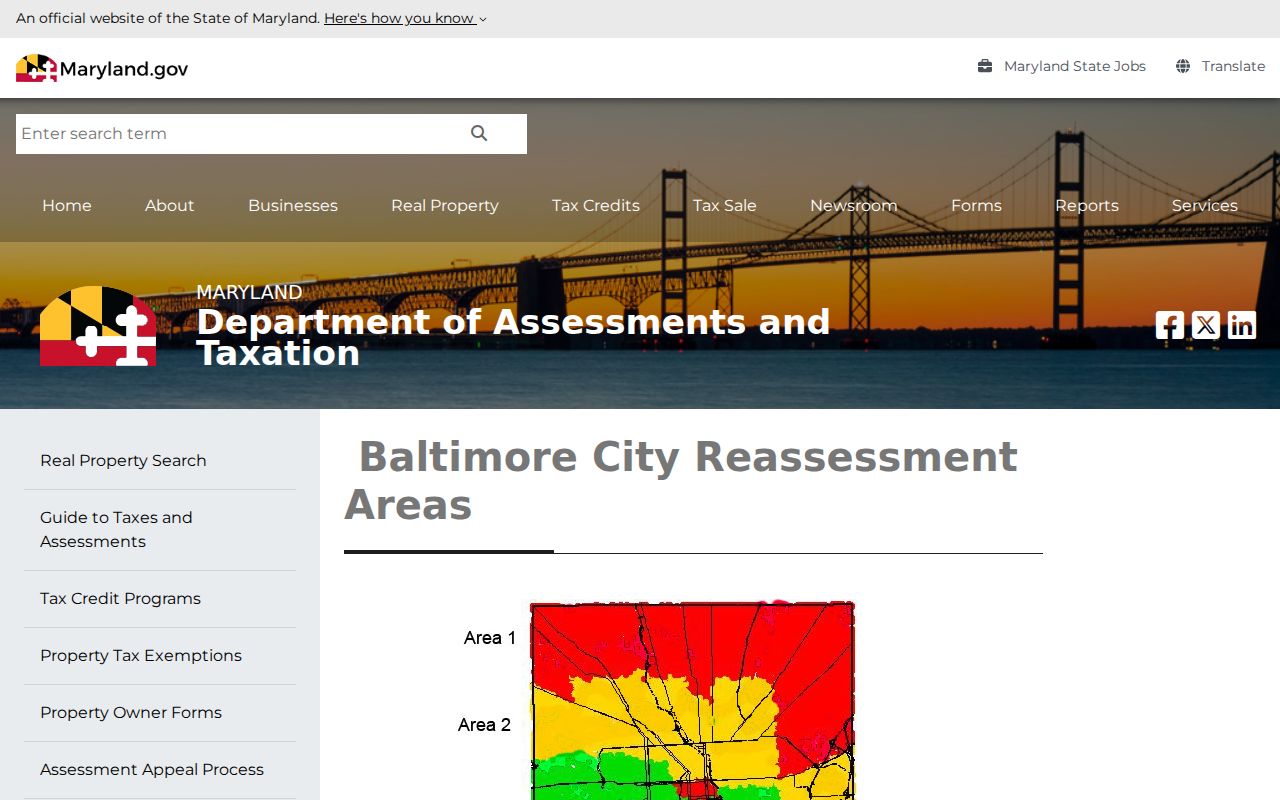
Area and effective date matter when you weigh two properties or two years against each other. A fresh assessment in one area should never be read as if all of Baltimore City was valued on the same date.
Baltimore City's Homestead Cap Changes Taxable Growth
SDAT's homestead-cap schedule lists Baltimore City's local cap at 4 percent effective July 1, 2024. The statewide cap is 10 percent. For an eligible principal residence, the cap can restrain yearly growth in the taxable assessment. It does not lower or redefine the full cash Current Value. Credits, exemptions, and phase-in rules can shift the tax calculation too, so report them as separate lines rather than carving them out of full cash value to invent a market figure. For bill and appeal mechanics, see Baltimore City property tax records.
Compare Baltimore City Value and Consideration
SDAT defines Consideration as the recorded price for which title transferred, and Transfer Date as the recording date, which can trail closing. CityView exposes SALEPRIC, SALEDATE, DEEDBOOK, and DEEDPAGE fields. For the legal transfer and any consideration notation, the deed image and index remain the stronger deed records.
| Comparison item | Question to ask | Possible reason for a difference |
|---|---|---|
| Transfer date | Is it recording or closing? | Document recorded after settlement |
| Consideration | Does the deed explain the amount? | Nominal, exempt, family, or partial-interest transfer |
| Parcel scope | Does one price cover more than one lot? | Multi-parcel conveyance |
| Assessment date | Was value set before the sale? | Different measurement date and purpose |
Never label a transfer an arm's-length market sale without the deed and its context. A recorded amount can be perfectly accurate as consideration yet a poor estimate of current market value.
Baltimore Vacant-Land Reviews Can Shift Comparisons
SDAT announced a Baltimore City vacant-property assessment initiative in August 2025. That change matters for vacant lots. Manual review or revised land treatment can make a year-to-year movement break from the ordinary three-year cycle. Before drawing any trend, check VACIND, NO_IMPRV, land value, assessment area, and the dated notice. A vacant-lot comparison should also weigh zoning. It should weigh current parcel geometry, the tax account, and recent transfer context. The initiative does not mean every vacant parcel changed. It does not mean any specific assessment was wrong.
Resolve Baltimore City Value Conflicts
SDAT, CityView, the city tax portal, and a deed can show different figures while none of them is meaningless. Rank each source by the question asked. SDAT governs the assessment field and year. The tax portal holds the year-specific bill summary. The deed settles the legal transfer. CityView serves as a convenient municipal extract.
Baltimore City Property Value Limits
An assessed value exists for public assessment and taxation. It is not a promised sale price, a current private appraisal, a repair estimate, or proof that a past consideration was an open-market deal. Its effective date may also differ from the day you read the record.
Value versus price. A Baltimore City assessed value is not what a property will sell for, and it is not an appraisal. Obtain a qualified appraisal for a current market-value opinion.
Assessment data flows through more than one channel. The public SDAT portal handles parcel searches, and its glossary defines the fields you will encounter. The Baltimore City assessment office sits at 6 St. Paul Street, 11th Floor, reachable at 410-767-8250 with posted hours of 8 to 5. Confirm the current assignment and hours before relying on an office visit.
The city tax portal adds year-specific tax-account context. You can pull it by fiscal year, block and lot, address, or owner. Its figures belong to the selected bill year. They shift after a payment, adjustment, credit, interest posting, or redemption. Treat them as tax data, not as another reading of the assessment. The two systems measure different things.
For transfer evidence, take the Liber/Folio reference into Maryland Land Records online after creating a free Maryland State Archives account. You can also use a courthouse terminal. Maryland Courts' fee schedule lists ordinary deed copies at $0.50 per page. Certification and special formats carry separate charges. The deed itself can explain consideration, parcel scope, and capacity that no value summary captures.
When portals disagree, keep each dated value side by side instead of picking a winner. A just-recorded transfer often reaches Land Records before SDAT or CityView refreshes. Timing gaps are normal. The source timestamp, assessment effective year, transfer recording date, and selected fiscal year keep the comparison honest.