
Fields in Baltimore City Property Tax Records
Read the city bill and the state assessment together, but cite them separately. A bill belongs to one fiscal year. Its balance can shift after a payment or adjustment. SDAT's side of the record describes full cash value, the prior base, and phase-in amount. It also shows land and improvement splits, and credits. Neither document proves who the current legal owner is. The deed records hold that answer, not the tax roll.
| Field | What It Shows | Official Source |
|---|---|---|
| Current Value | Full cash value at the most recent assessment | Maryland SDAT |
| Base Value | Full cash value before that assessment, often three years earlier | Maryland SDAT |
| Land / Improvements | Separate parts of the full value | SDAT and CityView |
| Phase-in / tax base | Amount used while an increase is phased for tax calculation | SDAT and bill data |
| Credits / exemptions | Adjustments that can change taxable amount or bill | SDAT and city bill |
| Balance and status | Charges, payment, delinquency, interest, and penalties for a year | Baltimore City tax portal |
Never confuse a tax bill with a recorded sale value. SALEPRIC, or Consideration, belongs to the transfer record. Current Value is the assessment figure. The phase-in is just a tax-calculation measure. Each number answers a different question about the same parcel.
Three Baltimore City Tax-Portal Search Routes
The Baltimore City real-property tax portal offers three ways in. The first route asks for a Year and accepts Block plus Lot. The second takes an Address. The third works from an Owner name. The portal's own example, 401 E Fayette St, shows the abbreviation style the city uses. Keep those abbreviations when repeating a query later.
| Route | Required or Useful Input | Best Control |
|---|---|---|
| Year + Block/Lot | Required year, block, lot | Exact parcel and fiscal period |
| Address | Premises string used by the city | Fast check for a known location |
| Owner | Name as indexed by the tax system | Discovery only; verify parcel and deed |
The official tax lookup screen displays the fiscal-year, block/lot, address, and owner routes together.
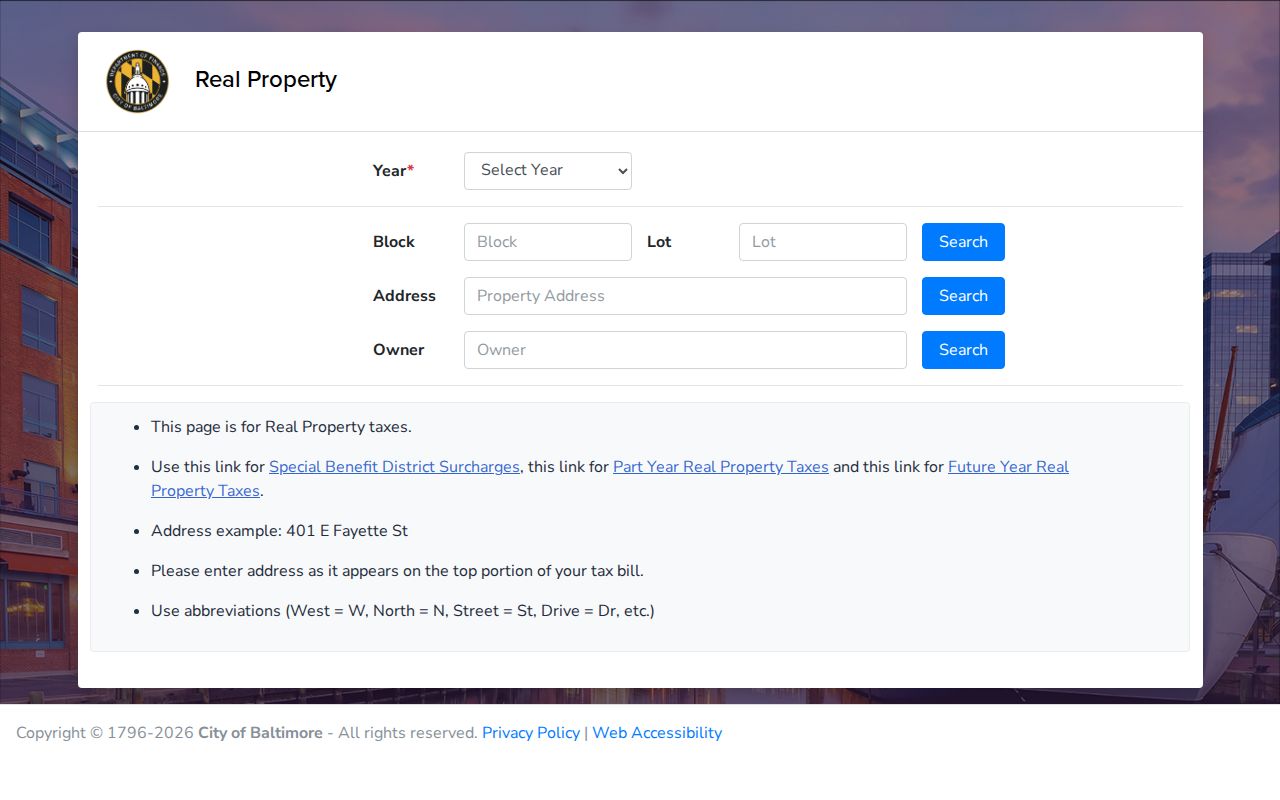
The result screen shows why the fiscal year belongs in every citation. A year's bill can differ from the next. Record the year, the bill or account identifier, block and lot, premises, owner display, base, charges, credits, balance, and the date you accessed it.
Look Up a Baltimore City Tax Bill
Start with the most stable key you have. Block and lot avoid the traps of a similar street name or a normalized owner spelling. Address helps when the parcel key is unknown. Owner search works best as a first pass, followed by a parcel check to confirm the match.
- Select the fiscal year in the city real-property portal.
- Enter block and lot, or use the address route to identify the account.
- Save the bill identifier, charges, credits, balance, interest, and payment status.
- Open the SDAT parcel record and compare Current, Base, phase-in, land, and improvement values.
- Check the notice and any appeal record before drawing a conclusion from a changed value.
- Assessed or Current Value
- Maryland's full cash value for assessment purposes.
- Phase-in assessment
- The amount used as an increase is phased into the tax calculation.
- Homestead cap
- A limit on growth of taxable assessment for an eligible principal residence, not a limit on full value.
- Tax lien
- A claim arising from unpaid tax that requires record-level verification.
Baltimore City Full Cash Value
Maryland Tax-Property §8-103 sets the real-property assessment level at 100% of full cash value. SDAT's Current Value is the practical full-cash field on the record. No separate Baltimore City fractional assessment-ratio field exists. Treat Current Value as the figure. Keep it distinct from the phase-in amount or the TAXBASE used for a particular bill.
The SDAT glossary gives the basic relation: phase-in assessment divided by 100, multiplied by the tax rate, equals the bill. Credits and exemptions can change the result. The recorded sale price is yet another number. It may reflect a family transfer, a partial interest, nominal consideration, multiple parcels, or a date different from closing. Compare figures carefully before drawing conclusions.
Baltimore City's Three Reassessment Areas
SDAT rotates Baltimore City property through three reassessment areas. Area 1 became effective January 1, 2025. It returns January 1, 2028. Area 2 took effect January 1, 2023. Its next reassessment lands January 1, 2026. Area 3 became effective January 1, 2024 and comes up again January 1, 2027. Before relying on any of those dates, recheck the official Baltimore City reassessment-area page.
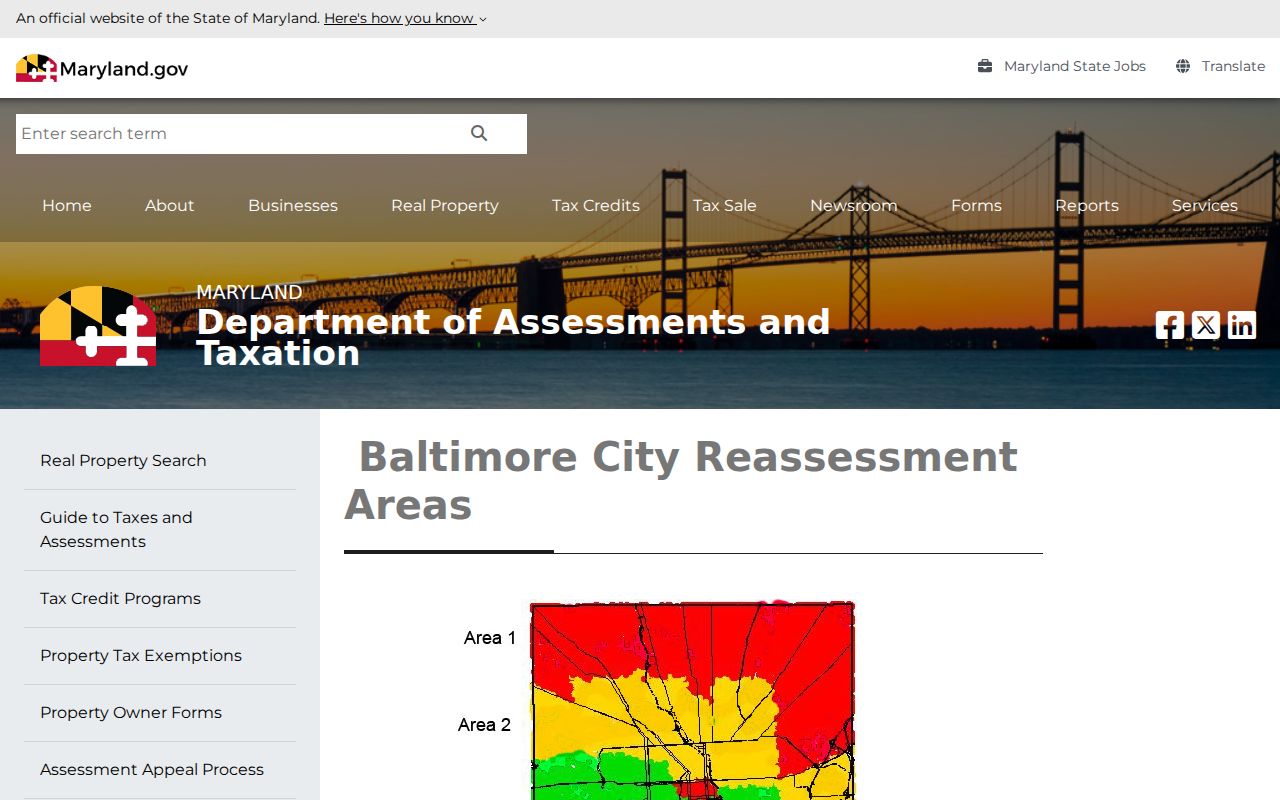
The rotating schedule explains why similar parcels get new notices in different years. It does not explain any single parcel's change. For that, compare the notice, the property characteristics, and the value fields side by side.
Baltimore City Homestead Cap Limits
SDAT's published cap table lists Baltimore City's homestead cap at 4% effective July 1, 2024. The statewide cap is 10%. For an eligible principal residence, the cap limits how fast the taxable assessment can grow year over year. It does not force Current Value to match the phase-in, erase an assessment increase, or promise the same bill every year.
Keep the applicable credit record with each assessment notice. A credit can change the amount due even when full cash value holds steady. The reverse also happens. A higher Current Value may not reach the taxable base at once, because phase-in and cap rules operate separately.
Payment Channels for Baltimore City Property Tax
The city's payment directory lists online ACH and card service. Phone, mail, and in-person channels are also listed. For real-property tax questions, the directory lists 410-396-3987, mail to P.O. Box 17535, and counter service at the Abel Wolman Municipal Building, 200 Holliday Street. Hours run 8:30 to 4:30. Card payments carry a 2.39% convenience charge for non-utility transactions, while ACH carries none.
Fees, hours, and instructions can change. Confirm them on the live payment directory before sending funds or visiting. Save a receipt or confirmation number, and allow posting time. An online balance can move after a payment, adjustment, tax-sale redemption, or later credit. That is why any Baltimore City property tax lookup deserves a timestamp.
Tax-Sale Status Does Not Transfer Title
A delinquent amount, tax-sale layer, removal-request table, or candidate list does not prove a sale happened. It does not prove title changed hands. Record the sale cycle, notice date, parcel identifier, amount and status if shown, and redemption or payment status. Add any later deed or release. Then verify against the city tax record and the recorded instrument itself.
The city's GIS includes a 2026 tax-sale property layer. Map inclusion is a lead, nothing more. Vacant parcels need equal care. SDAT describes a recent vacant-land initiative that can complicate year-to-year value comparisons. For vacant land, compare parcel geometry, VACIND or no-improvement fields, zoning, assessment, tax status, and deed. Check any code or receivership record before reaching a conclusion.
Contest a Baltimore City Assessment on Time
An ordinary SDAT appeal must land within 45 days of the assessment notice. Miss that window and options narrow fast. A non-reassessment year works differently. A petition for review opens on the first working day after January 1. Purchasers get a special route too. SDAT allows a 60-day appeal for anyone who bought between January 1 and June 30. Hang onto the notice date and delivery method. A portal submission alone does not prove timely filing.
Appeals climb a defined ladder. The path starts with the Supervisor of Assessments. From there it moves to the Property Tax Assessment Appeal Board, and it can reach the Maryland Tax Court. Deadlines of 30 days are typical at each step. Written, phone, video, and in-person formats are all described, and no filing fee applies. The online start form asks for the county, notice number, and control number. So have those handy.
Appeal window. File the ordinary Baltimore City assessment appeal within 45 days of the notice and retain proof of submission; later stages have their own deadlines.
Ask for Missing Baltimore Tax Records
A record that exists but sits outside the public portal can still be requested. The Maryland Public Information Act is the tool. Direct the request to the office holding the record, and be specific. Name the address or block/lot. Give the tax year or date range. State the record type, your preferred format, and whether you want inspection or copies. Ask for things an office can actually produce. Examples include an assessment notice, a parcel export, a tax-sale notice, or correspondence. Do not ask for a new legal conclusion.
Timing rules are set by statute. Under General Provisions §§4-203 and 4-206, the custodian generally grants or denies within 30 days. Production can sometimes exceed 10 working days. In that case, written notice is expected within 10 working days. It should explain the reason, the estimated time, and the fee range. The first two search hours are generally free. Copy, certification, and special-format fees can still apply.
Keep records of your request. Note the request date and tracking number. Record the fee estimate, response date, production date, and exact file names or page counts. A denial or redaction should identify its legal basis and explain review options. If a fee estimate is open-ended, ask the office to pause before a stated ceiling is crossed. These controls matter for a dynamic tax account. A later payment, credit, redemption, or adjustment can change things. The earlier production stays accurate for its date but is no longer current.